On Friday 30 October 2026, La Française de Mécanique closes for good in Douvrin, in the Pas-de-Calais. For 57 years the plant assembled more than 50 million engines — among them every one of the 970,315 PRV V6s, from 1974 to 1998. A look back at a giant of the French motor industry, born on a marsh in the coalfield.
THE DOUVRIN ASSEMBLY SHOP IN 1977, AT THE LAUNCH OF THE J ENGINE — PERIOD PHOTO (LA FRANÇAISE DE MÉCANIQUE), COLOURISED AND ANIMATED BY AI; THE SCENE IS GENUINE, THE COLOURS AND THE MOVEMENT ARE NOT.
This Friday, La Française de Mécanique closes its doors for good in Douvrin, in the Pas-de-Calais. Stellantis had announced the gradual end of combustion engines on the site on 24 July 2025, then set the date at 30 October 2026. The last assembly lines stopped in July; since then the plant had only been machining parts, and some sixty people are left to close the doors.
The staff have been moved to the Stellantis plants in Hordain and Valenciennes, helped into retirement, or hired by ACC, the battery plant built just across the road. Trémery, in Moselle, becomes the last Stellantis site assembling combustion engines in France.
For us, Douvrin is our engine's home address: every one of the 970,315 PRV V6s came out of this plant. Its story deserves to be told.
It all starts with an agreement: in April 1966, Peugeot and Renault, rivals everywhere else, team up to design mechanical components together. On 28 January 1969, the Peugeot-Renault Association decides to set up a joint subsidiary, owned in equal shares: La Française de Mécanique. It settles in Douvrin and Billy-Berclau, between Lens and Béthune, in a coalfield that is losing its pits — the plant is one of the sites the French State wanted in order to give the region new work.
The land is a marsh, which the locals actually call the Marsh. For months, twenty-tonne lorries dump 600,000 m³ of shale from the slag heap of pit no. 7 at Wingles to level it. Work starts on 14 May 1969, the foundry casts its first crankshafts in 1971, and the first engine is assembled in December that year. On 5 May 1972, minister François-Xavier Ortoli opens the plant in front of the heads of Peugeot and Renault, François Gautier and Pierre Dreyfus. In October, its first engine, the X, goes into the new Peugeot 104.
Meanwhile, Peugeot and Renault have brought Volvo into a shared upmarket engine: the Franco-Swedish PRV engine company, founded in 1971. PRV sells the engine to the three makers; La Française de Mécanique builds it on PRV's behalf. A second phase of construction starts in 1972 to put it into production.
On 3 October 1974, opening day of the Paris Motor Show, the plant launches its second engine: the Z, which we know as the PRV V6. A 90° V six of 2,664 cc — born a V8, as we told you —, billed as the first all-aluminium, pressure-die-cast V6 made in France, and weighing just 152 kg. Two versions at launch, with carburettors and with K-Jetronic mechanical injection. It first goes into the Volvo 264 and the Peugeot 504 Coupé and Cabriolet.
Assembling the Z looks nothing like one long line. The shop is split into eight sub-assemblies, each entrusted to a group of six to ten people who build a complete sub-unit, with buffer stocks so they can work at their own pace. One detail shows how demanding it was: because of the way the crankshaft is balanced, every connecting rod must weigh exactly 684 grams once machined. Each one is weighed, then corrected.
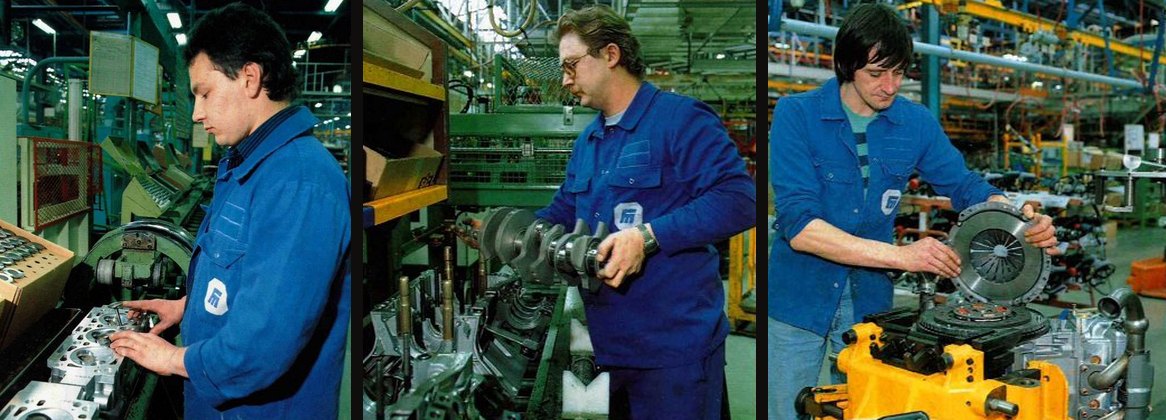
DOUVRIN, 1991 · VALVES INTO THE HEAD, CRANKSHAFT INTO THE BLOCK, CLUTCH MECHANISM · BROCHURE OF THE SOCIÉTÉ DES MOTEURS PRV
At launch, output is due to rise from 46 to 80 engines a day. On 7 November 1977, a major fire breaks out in the Z machining shop; the assembly shop still keeps up its 290 to 310 engines a day, and the year ends on 67,000 V6s. In May 1989, 325 a day are still coming off the line.
On 15 June 1998, a ceremony surrounds the last Z engine, with one representative from each production area. The staff magazine, Élan, does the sums: 970,315 PRV V6s built in twenty-four years, 180 a day on average. And behind the three makers, a crowd of customers.
| Maker | Engines taken | Of which |
|---|---|---|
| Renault | 455,051 | including Chrysler 144,840, DeLorean 9,864, Venturi about 400 |
| Peugeot | 253,244 | including Citroën 47,423, Fiat/Lancia 9,097, Talbot 1,244 |
| Volvo | 262,020 | until it pulled out, in July 1989 |
TOTAL 970,315 ENGINES, 1974-1998 · SOURCE: ÉLAN NO. 151, OCTOBER 1998
The Douvrin V6 did not stop at saloons: Élan also lists motorsport, from Le Mans to the Paris-Dakar, Panhard armoured vehicles, and even an aircraft. At the same time, the Z staff move on to the new ES/L V6 — a 60° V6 that has nothing of a PRV left in it.
The V6 was only one chapter. Douvrin built the X for the Peugeot 104, Renault 14 and Peugeot 205 (more than 5.2 million units), the J “Douvrin” for the Renault 20, 25 and Espace, the Peugeot 505 and the Citroën CX (nearly 4.5 million), then the TU, its biggest success, with more than 15.6 million units from the Citroën AX onwards. Then came the D for the Renault Twingo and Clio, the HDi diesel designed with Ford, the “Prince” developed with BMW, and the PureTech three-cylinders.
The millionth X engine comes out on 5 January 1978; the plant's fifty-millionth engine, in 2021. At the end of 2013, Renault announces it is selling its share; in 2014, La Française de Mécanique becomes a wholly PSA plant, then, in 2021, Stellantis Douvrin. In the mid-1980s, it employed more than 5,600 people.
Our library holds two documents born there: issue 77 of Élan, from February 1985, devoted to the two V6s of the new Alpine, and the brochure published in April 1991 by the Société des Moteurs PRV on the engine of the Alpine A610 — the one the photos of the line above come from.
We will keep honouring that memory as best we can: by keeping these engines running, preserving their documents and telling their story. Did you work at La Française de Mécanique, on the V6 line or elsewhere? Your memories, photos and documents matter to us: you can contribute, and the discussion goes on in the forum.
Thank you to La Française de Mécanique and to its history. Without Douvrin, some automotive legends could never have existed: the DeLorean from Back to the Future, the Alpine A610, the Venturi 400 GT, the Safrane Biturbo… and every PRV V6 still on the road today. Thank you too to all the women and men who kept the plant running for 57 years.
Why is the PRV V6 a 90° engine? · The PRV V6 — codes and generations · The DeLorean and the Douvrin V6 · Volvo 260 — the first PRV car · The manuals library
Élan, staff magazine of La Française de Mécanique: no. 3 (December 1971), no. 19 (October 1974), no. 40 (January 1978), no. 99 (May 1989), no. 151 (October 1998) — the total of 970,315 is the one in no. 151 (the timeline on francaisedemecanique.fr gives 968,290) · Totals for the other engines: francaisedemecanique.fr · Closure: Stellantis announcements of 24 July 2025 and 16 July 2026, reported by AFP, L'argus, France 3 Hauts-de-France and ICI · Change of ownership: PSA press releases of 2013 · Photos: assembly shop in 1977, La Française de Mécanique (francaisedemecanique.fr gallery), colourised and animated by AI; V6 line in 1991, brochure of the Société des Moteurs PRV (PRV Concept library)