The most famous car in cinema history is an American built in Northern Ireland, styled in Italy, developed in England — and powered from Douvrin. How did the PRV V6 end up there? How many engines left for Belfast, and who paid for them? Why did the car refuse to restart when hot — and was the engine to blame? And what was the twin-turbo that was meant to change everything really worth?
John DeLorean left General Motors in 1973 with an idea for a light, frugal sports car. The targets he set with his engineer Bill Collins say it better than any speech: under 8 seconds from 0 to 60 mph, a 130 mph top speed, and EPA figures of 22 mpg city and 29 highway. Three engines were studied before the right one:
— the Comotor twin-rotor, the Wankel from the Citroën GS Birotor: it is the one the first brochures announced. The idea died with Citroën's bankruptcy in 1974;
— Ford's “Cologne” V6 from the Capri and Granada, long the favourite;
— the Citroën CX's 2-litre four, which powered the first running prototype of October 1976. Not enough: when DMC talked about turbocharging it, Citroën suggested it look for another engine.
That left the PRV V6. It cost more than the Cologne, but it was lighter and more powerful — and Renault, with capacity to spare at Douvrin, was more open to a deal than Ford. One argument weighed heavier still for a penniless maker aiming at the American market: the engine was already certified there. It was, displacement aside, the Volvo 260's — and the US Environmental Protection Agency let DMC skip the 50,000-mile durability test, which Volvo had already passed with the same tune.
The engine did not come alone. With it came the gearboxes of the Renault 30 — five-speed manual or three-speed automatic — and that choice forced another: designed for a front-wheel-drive car, these gearboxes, once moved to the rear, meant mounting the V6 lengthways behind the axle rather than ahead of it. A workshop detail along the way: to go from front to rear, the engine-and-gearbox unit is turned through half a turn, and everything then spins backwards relative to the road. So the differential has to be flipped — otherwise the car would have five reverse gears with the manual gearbox (three with the automatic) and a single forward one. The mid-engined sports car of the first drawings became a rear-engined one — the layout of an Alpine A310 V6.
ANIMATION — A PHOTOGRAPH OF A DELOREAN DMC-12 IN BACK TO THE FUTURE TRIM, SET IN MOTION BY ARTIFICIAL INTELLIGENCE. THE CAR AND THE SETTING ARE GENUINE; ITS ARRIVAL AND DEPARTURE NEVER HAPPENED.
130 bhp: that was the price of American regulations. The European version without a catalyst, quoted at 156 bhp, was built in only a handful of cars before the closure. And the car put on 227 kg over the original plan during its development at Lotus. DMC claimed 8.8 seconds from 0 to 60 mph; Road & Track measured 10.5.
Production started at Dunmurry, near Belfast, at the end of 1980; the last car left the line on 24 December 1982. In between: about 9,000 DeLoreans — 8,975 by the most quoted count, with estimates from 8,875 to 9,080 — and so at least as many V6s shipped from Douvrin. (The exact number of engines delivered, spares included, is given by none of the sources we found.)
Sales did not follow. By the end of 1981, 7,500 cars had been built and only 3,000 sold. In February 1982, DMC was more than 800,000 dollars behind on its interest payments “and suppliers like Renault were making threatening noises”; on 19 February the plant went into receivership.
What came next fits in one sentence of a UPI dispatch datelined London, 22 October 1982, in the days after John DeLorean's arrest in Los Angeles: “Renault, its biggest creditor, claimed it is owed $17 million for engines.” On 16 November a bankruptcy judge approved the sale of DMC's assets for 1.5 million dollars. Renault and the British government were among the secured creditors — 17 million each — ahead of 40 million in unsecured claims; the lawyers worked out that the settlement came to “about 3 cents on each dollar”.
The DeLorean's V6 starts from cold without fuss and runs smoothly. The trap comes later: you stop for ten minutes or half an hour, engine hot or still warm, you turn the key — and the starter churns to no effect. It is the fault that sticks to the car, to the point that the specialist who took over the marque devotes a whole article to it.
The engine has nothing to do with it: it is a matter of fuel pressure. K-Jetronic injection must stay pressurised once the ignition is off. Our DeLorean manual gives the figures: 3.3 bar of rest pressure at switch-off, and still at least 1.7 bar ten minutes later. If it collapses, the heat of the stopped engine boils the fuel in the injector lines lying in the vee: there is nothing but vapour behind injectors that only open at 3.5 bar. You then have to crank until the vapour is purged — “and at higher temperatures the battery may run down before the engine is able to start”.
The culprits are known, in order: the fuel accumulator, whose diaphragm wears out; the pump's check valve, which lets fuel run back to the tank; a seal in the fuel distributor; a mixture set too lean. And our workshop manual gives fair warning: on this injection almost nothing can be repaired — pump, check valve, accumulator and distributor are sealed units that are simply replaced.
It is not a flaw of the DeLorean alone: it is the nature of this mechanical injection, wherever the PRV V6 was given it. The workshop sheet for the 144 bhp Renault 25 V6 injection (Z7V, K-Jetronic) asks for exactly the same thing: 1.7 bar of rest pressure ten minutes after switch-off, 1.5 bar after twenty, for injectors that open between 3.5 and 4.1 bar — the DeLorean's values, to the digit. At Volvo, the 260 manual sets the minimum between 1.5 and 2.4 bar, and tells of the in-house cure: a pump added inside the tank in 1977, with a check valve “which reduces the risk of vapour lock”.
The rest of the car's reputation comes from even further away from the engine:
— The build quality of the first few hundred cars was “embarrassingly shoddy”: up to 200 hours of rework per car at the American quality centres before delivery; more than 2.5 million dollars of rectification, and 1.5 million in warranty claims.
— The alternator, an 80-amp Ducellier, could not keep up with every accessory running: the battery slowly went flat. A 90-amp Motorola replaced it in late 1981.
— Cooling: radiator at the front, engine at the rear, everything rests on two electric fans — which cut in at 97 °C and stop below 91 °C, says our training manual. Their electrical control is fragile, and when they fail to cut in the engine overheats — “the most common problem, and the one most likely to kill an engine”.
And the engine itself? The buying guide that draws up this list is categorical: properly maintained, it “will dismiss 300,000 miles with ease”. The DeLorean's PRV was not fragile; it was let down by what surrounded it.
The press tests were cruel: 9.5 to 10.5 seconds from 0 to 60 mph, when the rivals it targeted needed 7.5 to 8.5. John DeLorean knew it. In April 1981 he had car no. 502 shipped to Legend Industries on Long Island — Fred Dellis as president, Chris Theodore in charge of engineering — with a simple brief: make it fast.
Legend chose two small Japanese IHI turbochargers — the lightest, lowest-inertia units on the market — and two air-to-air intercoolers. “Practically every piece of the V6 engine had to be redesigned except the bottom end and the camshafts.” The result: an engine that pulls from 1,500 rpm in fifth, 0 to 60 mph in 5.8 seconds and the quarter mile in 14.7, timed by John Dinkel of Road & Track — the only journalist to have driven it. At Bridgehampton in 1981, the twin-turbo DeLorean outran a Ferrari 308 and a Porsche 928. The output was never published: “around 200 bhp”, says the rumour; the owner of a restored car puts it at about 230 bhp at 0.55 bar.
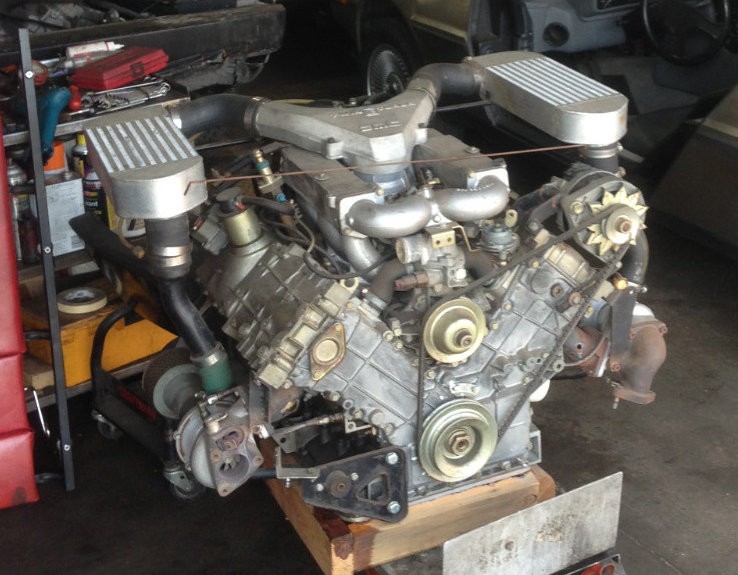
THE LEGEND INDUSTRIES TWIN-TURBO V6 FROM DELOREAN NO. 530, OUT OF THE CAR (2016) — PHOTO CHRIS NICHOLSON, WIKIMEDIA COMMONS, CC BY-SA 4.0
John DeLorean ordered 5,000 engines, to be offered as a 7,500-dollar option. Only four cars were ever converted: nos. 502 and 530 as twin-turbos, 528 and 558 with a single turbo. DMC's bankruptcy took the project down, and Legend Industries with it.
It would take twelve years for a twin-turbo PRV V6 to be genuinely sold as a production car: the Safrane Biturbo.
Before the glory there was luxury — and a publicity stunt. At the end of 1980, American Express offered its members a DeLorean plated in 24-carat gold: a hundred cars at most, at 85,000 dollars apiece, a small fortune. Only two found a buyer. Three gold cars finally came out of the factory or what was left of it: no. 4300, manual, now on display at the National Automobile Museum in Reno; no. 4301, automatic, which spent years in the lobby of a bank in Snyder, Texas, before joining the Petersen Automotive Museum in Los Angeles; and no. 20105, assembled after the factory closed from the set of spare panels kept in case one of the first two was damaged — it is in a private collection. Under the gold as under the stainless steel, the same V6 from Douvrin.
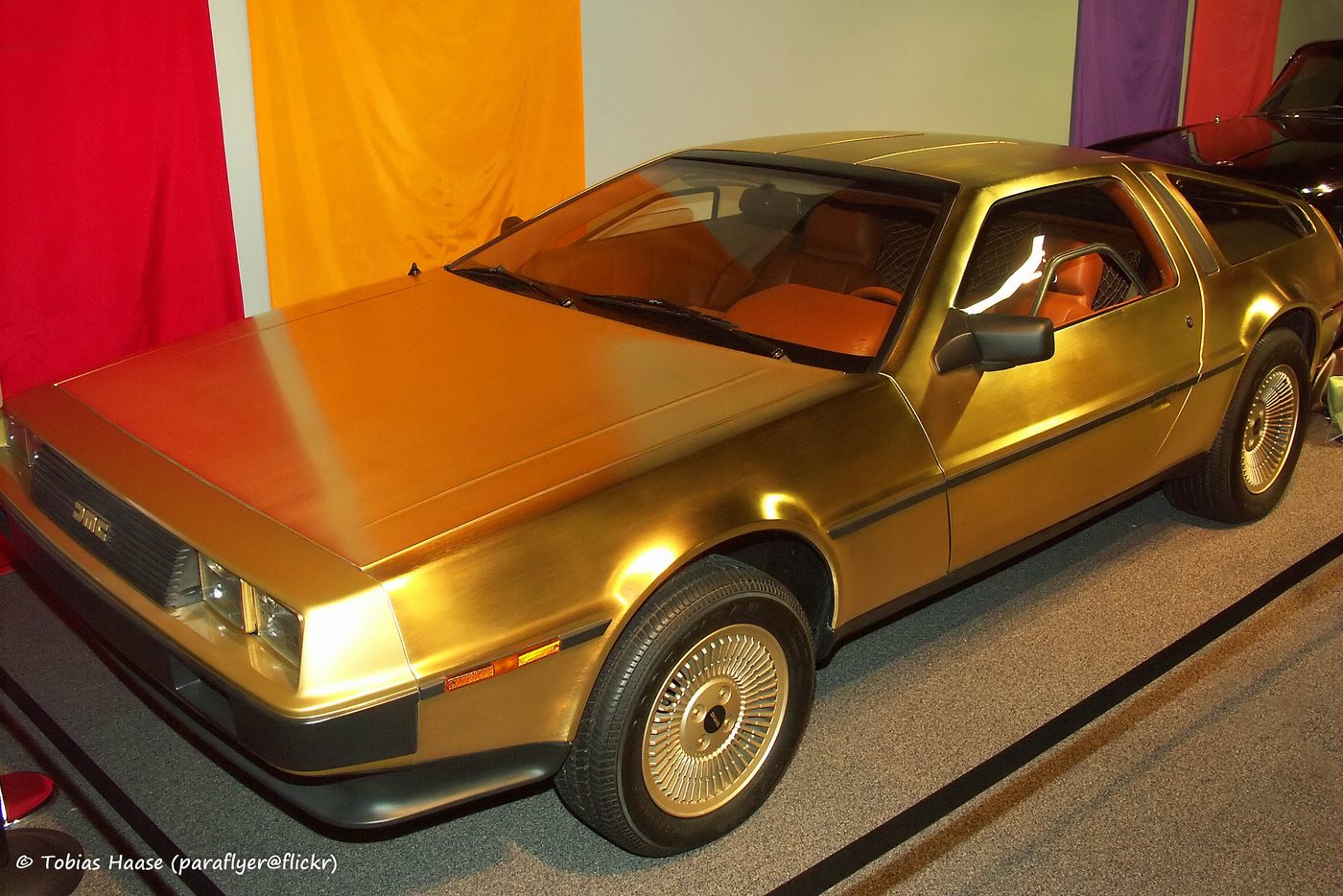
THE GOLD-PLATED DELOREAN AT THE NATIONAL AUTOMOBILE MUSEUM IN RENO, NEVADA (2005) — PHOTO TOBIAS HAASE, WIKIMEDIA COMMONS, CC BY 2.0
The last DeLorean left the factory on 24 December 1982. Back to the Future reached American cinemas on 3 July 1985. In between, the marque had vanished, its founder had been arrested then acquitted, and the unsold cars had been sold off cheap.
The DeLorean is a concept that was never finished: the factory closed before its development was complete. That is the car the film turned into a worldwide icon. Six DeLoreans and one glass-fibre replica were used to shoot the trilogy; three still exist. An irony for lovers of the Douvrin V6: the growl heard on screen is a Porsche 928's V8, and in the third film two of the desert cars ran on a dune-buggy chassis with a Volkswagen engine. Under the stainless steel of all the others, though, it really is the PRV — an engine Renault never finished getting paid for, and that cinema made immortal.
Cinema then turned to the man. Driven (Nick Hamm, premiered at Venice in September 2018), with Lee Pace as John DeLorean and Jason Sudeikis as the FBI informant, tells the 1982 sting as a black comedy; the marque's historians took it to task for its liberties. Framing John DeLorean (Don Argott and Sheena M. Joyce, Tribeca, April 2019) mixes archive footage, interviews and scenes re-enacted by Alec Baldwin. And the BBC documentary series Myth & Mogul: John DeLorean (three episodes, on Netflix since July 2021) covers the whole trajectory, from Pontiac to the courtroom. In none of the three is much said about the engine.
Sources: Ate Up With Motor — “The Saga of the DeLorean Motor Company” (engine choice, certification, Renault gearboxes, rectification costs); UPI, London, 22 October 1982 (Renault's claim) and UPI, 16 November 1982 (sale of the assets); Wikipedia — DMC DeLorean (production, faults, filming); Classic DeLorean Motor Company — “Hot Start Issues” and “Gold Plated DeLoreans”; Jeff's 1981 DeLorean — the accumulator; Petrolicious — buying guide; DeLoreanDirectory — twin-turbo no. 502 and P.J. Grady — Legend Industries; Wikipedia for Driven, Framing John DeLorean and Myth & Mogul. Technical values read in the manuals of our Library: DeLorean workshop manual (fuel system), DMC training manual of March 1981, DMC specifications, workshop sheet for the Renault 25 V6 (Z7V, 144 bhp) — which prints its pressures in “mbar” for values that are kilopascals — and Volvo's CI injection manual for the B27/B28.