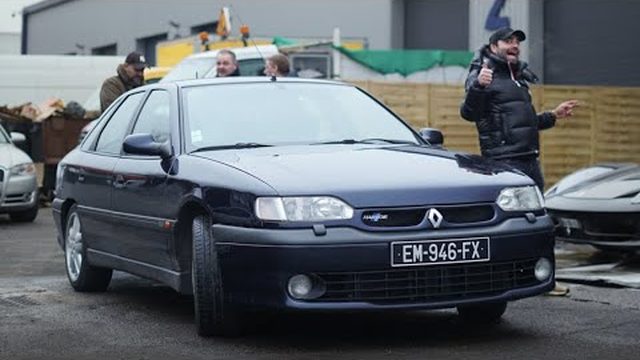
March 1992: Renault promises a 268 bhp saloon to chase BMW and Mercedes on their own ground. It would only be delivered two years later, after a round trip to Germany where the car was taken apart piece by piece. It found just 806 buyers — and its power was capped by its gearbox.
The Geneva show of March 1992 discovered a Safrane barely launched, and already a version that was anything but ordinary: a prototype with yellow headlights, two turbochargers grafted onto the PRV V6, four driven wheels. On paper, the French answer to the great German express saloons.
Yet it would take until November 1993 for a press presentation, and the beginning of 1994 for the first cars to reach the road — with white headlights this time. Nearly two years between promise and delivery, which Renault put down to a long reliability programme, without ever going into detail.
ANIMATION — A PHOTOGRAPH OF THE SAFRANE BITURBO SET IN MOTION BY ARTIFICIAL INTELLIGENCE. THE CAR IS GENUINE; THE OVERTAKE NEVER HAPPENED.
The idea of bolting two turbos onto a PRV V6 was not new. In the early 1980s, judging his DMC-12 too slow, John DeLorean personally entrusted the engine to Legend Industries on Long Island: specific pistons, rods, gaskets and head bolts, for an output that was never published — around 200 bhp by repute. DMC's bankruptcy in 1982 took the project with it — only four cars were converted, two of them twin-turbo, and the twin-turbo PRV remained a collector's curiosity.
The Safrane Biturbo is therefore, twelve years later, the first twin-turbo PRV V6 actually sold as a production car. A first that took a decade and two continents to materialise.
The paradox is complete: to challenge Germany, Renault turned to Germany. And the process went well beyond simple subcontracting. It was not bare bodyshells that crossed the Rhine, but complete Safrane V6 RXE Quadra cars, taken from the end of the line at Sandouville.
They went to the Irmscher workshop in Swabia, where the car was dismantled and the engine removed. The V6 then travelled to Hartge in Beckingen, which designed the twin turbocharging and adapted the running gear to the new performance. Irmscher, meanwhile, modified the shell and fitted the widened body panels — then put the transformed engine back under the bonnet. Irmscher was no random choice: it was already assembling the Safrane V6 Baccara.
This back and forth explains the price. Taking a finished car, undoing it, rebuilding it elsewhere: the process was long and costly, and it showed on the price list.
The Biturbo did not invent four-wheel drive: it inherited it from the production Safrane Quadra. And that is precisely where the project met its limit. The Safrane is a front-wheel-drive car with a transverse engine, an awkward architecture as soon as you want to add four driven wheels.
On a rear-wheel-drive car with a longitudinal engine, torque runs in a straight line from the crankshaft to the propshaft. With a transverse engine, it has to be turned through a right angle towards the rear, inside a volume that is already full — a more tortuous, more fragile path, and one that cannot simply be made bigger for want of room.
The weak link has a name. The Safrane V6 Quadra used the five-speed manual PK7; for the Biturbo, Renault derived the PK9 from it, with strengthened gears. Strengthened, but not redesigned: it remained the gearbox of a naturally aspirated saloon, and it could not take the torque of two turbochargers. Power was therefore capped at 268 bhp to preserve the gearbox.
The figure used as a selling point was therefore not a technical maximum: it was a safety ceiling. With a gearbox to match, Hartge could have gone beyond 300 bhp. The Quadra four-wheel-drive system itself would remain a sensitive point, too specific to be repaired outside the dealer network.
Our readers add a step this article did not tell: the pre-production cars ran a PK1, which could not take the torque. Several variants were tried before the strengthened PK9 was settled on — the gearbox was not a detail sorted out at the end, it was the whole problem.
Thirty years on, two people who know the car intimately read this article and completed it — they are thanked at the foot of the page. They describe a way of working that the general-interest data sheets never mention: on this engine the wastegate is not the regulator, it is the floor.
The KKK K04 dump valves are set at 550 mbar (± 30). On their own, they would cap boost at 0.55 bar. But the injection ECU, according to manifold pressure, manages a leak on the pneumatic circuit that controls them: by bleeding off the control pressure, it makes them see less than reality, and boost climbs past the setting. No leak, no extra boost — you fall back to 0.55 bar.
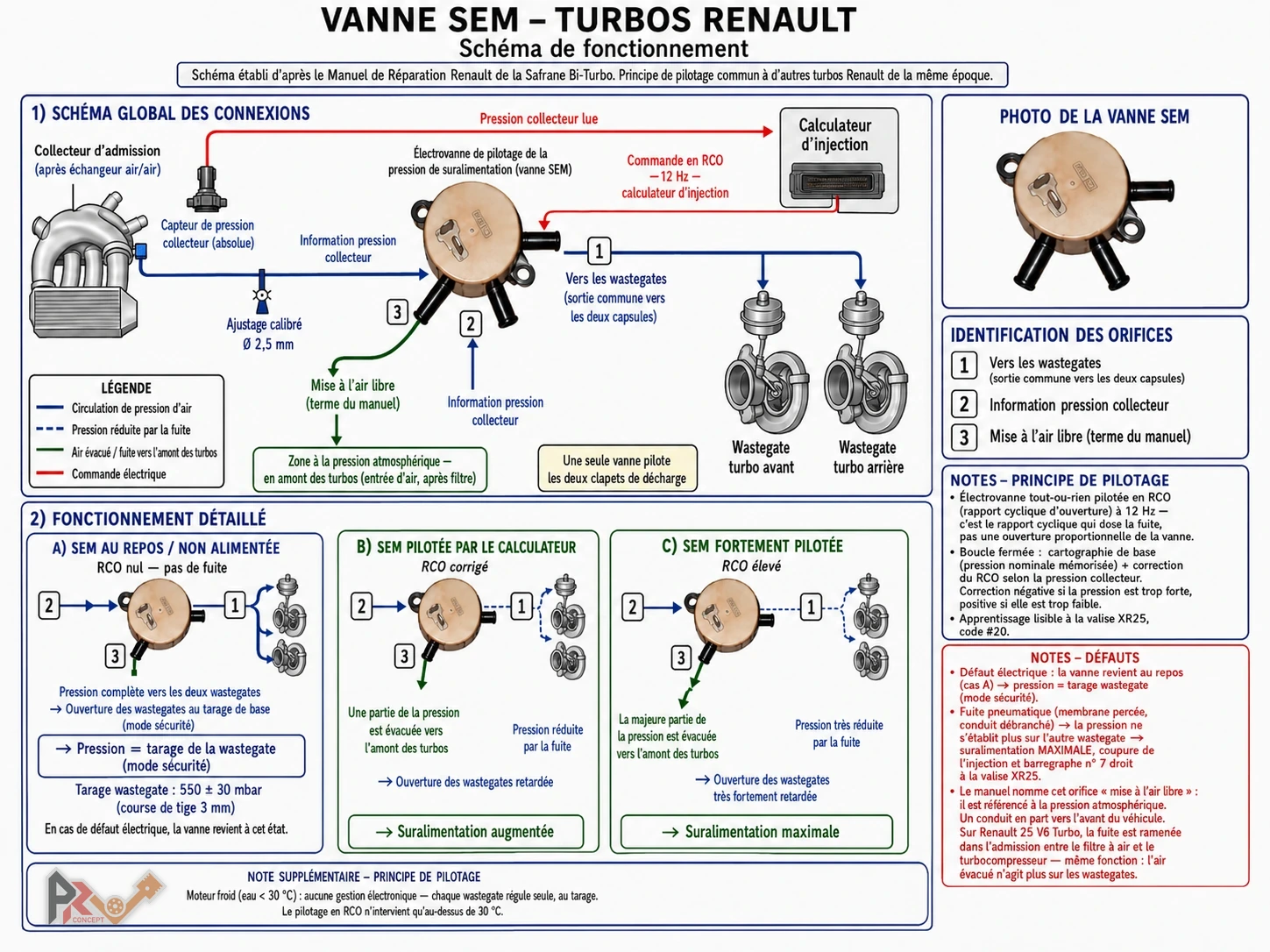
THE SEM VALVE — ONE SOLENOID FOR BOTH WASTEGATES: IT CREATES THE LEAK THAT LETS BOOST CLIMB. CLICK TO ENLARGE.
It is exactly the arrangement used on the 205 bhp Renault 25 V6 Turbo, and it allows boost to be metered gear by gear. The assumption is that in first there is no leak at all — the Biturbo then sees nothing but the valve setting — and that in second the leak stays small: full boost would only arrive from third onwards. The reference map, for its part, is indexed on engine speed: target pressure follows a curve that depends on revs, and no strategy tied to the gear engaged appears in it. But the ECU also receives a road-speed signal — with engine speed, it has everything it needs to work out the gear. Nothing stands technically in the way of it.
There is a proof by absurdity of all this, and it is written into the car: below 30 °C of coolant temperature, boost is not managed electronically at all — each wastegate regulates on its own, at its setting. Cold, the Biturbo runs on nothing but the setting of its two valves; the leak, and everything above it, only begins once the engine is warm.
To that they add two weak points no data sheet mentions, and that you only find out by taking things apart: undersized bearings, and a gearbox oil level set too low from the factory. None of it is written down anywhere — it is workshop knowledge, and it points once again at the link Renault never had time to redo.
On 15 May 1994, a Safrane Biturbo opened the Monaco Grand Prix as safety car. It was the peak of its public career, and just about its only moment of glory.
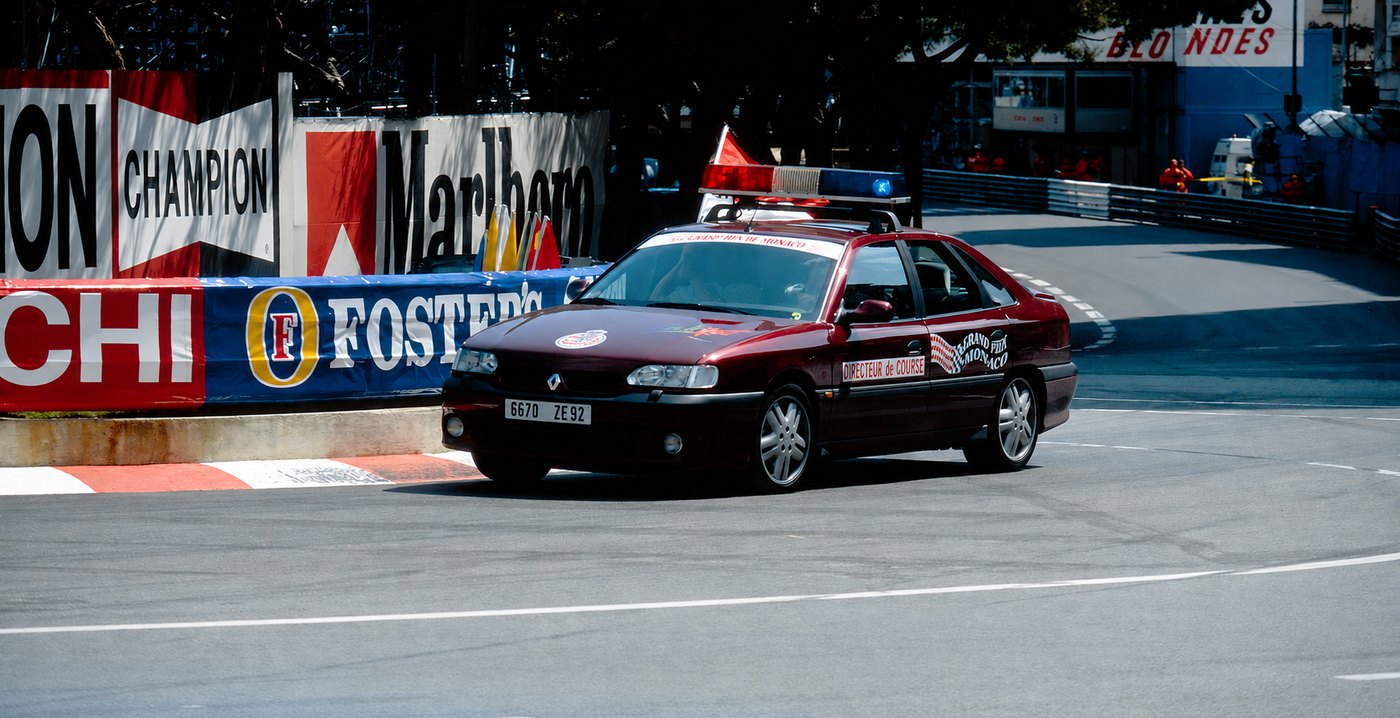
MONACO, 15 MAY 1994 — THE SAFRANE BITURBO AS CLERK OF THE COURSE CAR, AT THE MARLBORO HOARDINGS
The car never caught on: 806 units between 1994 and 1996, when the rivals it targeted sold in the tens of thousands. Those who did buy one, however, were hard to miss: Bernard Tapie enjoyed its hushed comfort, and football boss Louis Nicollin had his — since sold at auction. A confidential saloon, but not an anonymous one: its famous passengers are gathered in our Pop culture section.
Around 1995, Hartge nevertheless built a 280 bhp Laguna Biturbo prototype on the same block. Once bitten, Renault refused production — only five to seven cars were made. And there would be no phase 2 Biturbo: production stopped in 1996, the very year the Safrane was restyled. The saloon therefore carried on with the naturally aspirated 167 bhp Z7X — until the 60° L7X, which is not a PRV, replaced it in April 1999, at the very end of its career. An irony for a car whose gearbox had capped its engine: with the L7X, the Safrane simply lost its five-speed manual — only the automatic remained on the price list, while its smaller sister the Laguna kept the choice.
Today, rarity has done its work: Biturbos start at around ten thousand euros — for the fastest French limousine of its day, and the only production Renault powered by a twin-turbo PRV V6. Before it, only one other of the marque's express saloons had carried a turbocharged PRV: the Renault 25 V6 Turbo, back in 1985.
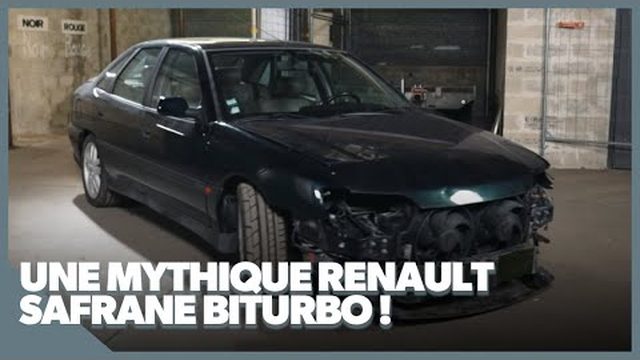
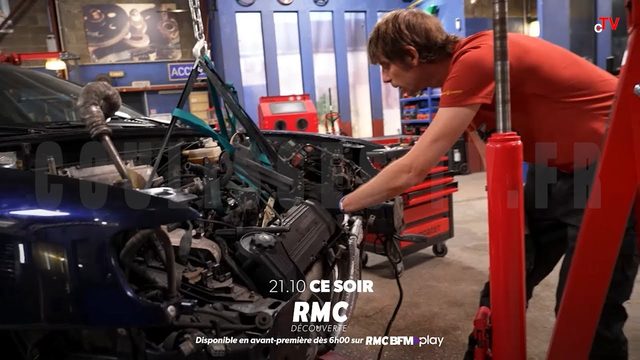
The best proof of the rehabilitation is this: in the space of a year, the two French restoration programmes each took on a Biturbo. In Vintage Mecanic (RMC Découverte, 29 October 2024), François Allain buys one and restores it — pointing out the collector's paradox: the value is rising, but not yet high enough to fund the work a car this rare demands. In Wheeler Dealers France (season 10, episode 9, 3 November 2025), Gerry finds one and the workshop takes it back to factory condition.
And the two diagnoses converge, thirty years later, on exactly what this article has been describing: tired turbochargers, a transmission that jolts, pneumatic self-levelling suspension out of order — and specific parts now practically unobtainable. The driveline that capped the engine in 1994 is still the sensitive point in 2025.
And the community is never far from the studio floor: to restore his Biturbo, Gerry Blyenberg sourced parts from fkp 94, president of the Safrane Automobile Club. Thirty years on, it is the clubs that hold the parts the dealer network no longer has.
On YouTube, Akram Junior has devoted two videos to it — “SAFRANE BITURBO !” on AKRAMJUNIOR DAILY and “Cette caisse est incroyable !” on AKR GANG. A saloon that sold badly, then was forgotten, and which a whole generation of enthusiasts is now discovering on screen.
DeLorean Twin Turbo (Legend Industries, early 1980s) — the stillborn forerunner: four cars converted, two of them twin-turbo, before DMC's bankruptcy.
Renault Safrane Biturbo (1994) — 268 bhp: the only production Renault. The car this article tells.
Venturi 400 GT (June 1994) — a few months after the Safrane: 408 bhp, 24 valves, the most powerful PRV road car. 400 GT file →
Laguna Biturbo (Hartge, circa 1995) — the 280 bhp prototype Renault turned down: five to seven cars.
And away from the road: the record-breaking WMs (up to 910 bhp), the Peugeot Oxia (680 bhp), the Venturi 600 LM (~600 bhp). The prototypes →
Acknowledgements — this article was read and completed by Oliv Safrane, president of Atelier Bartzen, and by fkp 94, president of the Safrane Automobile Club. What they know of this car, they know from working on it — and they agreed to have it written down here.
Sources: The Originals — Renault museum (March 1992 Geneva presentation), l'Automobile Ancienne (November 1993 press launch, sales from early 1994), Caradisiac and Rétro Passion Automobiles (Sandouville–Irmscher–Hartge route, prices, PK7/PK9 gearboxes), Renault Safrane Bi-Turbo workshop manual (valve settings, boost regulation) in our Library.