In 1985, Renault crowned its flagship saloon with a supercharged V6. But the 25 V6 Turbo is much more than a range-topper: it is the car that ushered the PRV V6 into its second generation. And five years later, its step from 182 bhp to 205 bhp would conceal one of the deepest engine overhauls in the history of the Douvrin V6.
Under the bonnet sits a PRV nobody had seen before: the Z7U, 2,458 cc (91 × 63 mm). With it, everything that defines the second generation arrives at once: a forged crankshaft with offset crankpins — firing finally becomes even, curing the historic criticism levelled at the 90° V6 —, full Renix electronic injection and turbocharging by a Garrett T3 with an air-to-air intercooler.
The figures in the period advertisement — reproduced below — speak for themselves: 182 bhp DIN at 5,500 rpm, peak torque of 28.6 m·kg held from 2,500 to 4,000 rpm, 225 km/h, 0 to 100 km/h in 7.7 s — and Bosch ABS as standard, a rarity in 1985. Keys-in-hand price on 1 May 1985: 175,000 francs. Renault billed it as “the fabulous turbo”; history proved them right.
PERIOD ADVERTISEMENT — “Le fabuleux turbo” (June 1985) · 182 bhp DIN · 225 km/h · ABS as standard
Facing Germany. In 1985, the executive class spoke German: BMW 528i (184 bhp), Mercedes 300 E (188 bhp), Audi 200 Turbo, not forgetting the Saab 9000 Turbo 16 or the Lancia Thema turbo i.e. Billancourt's answer came not through a straight-six but through turbocharging — and it hit the mark: the 25 V6 Turbo's times matched those of the Audi 200 Turbo, its closest technical rival, almost exactly. As for the standard-fitment Bosch ABS, it arrived a few months after the Citroën CX GTi Turbo — then the only two French cars to offer anti-lock brakes.
The summit of a range — and of the State. The V6 Turbo crowned a 25 range spanning from 80,500 to 175,000 francs (May 1985 prices). And its 182 bhp 2.5 turbo also powered the 25 Limousine: stretched by 22.7 cm and bodied by Heuliez in 832 examples, it carried President Mitterrand — the full story of the “gang des R25” is in Pop culture.
Before Renault officially muscled up its saloon, a young French workshop had taken care of it. Around 1989, HAS reworked the V6 Turbo — starting from the 182 bhp version — the way AMG did across the Rhine: turbocharger, intercooler, electronics and running gear all revised, for around 240 bhp. Only about ten cars were built, making the 25 HAS one of the most confidential PRVs — and one of the most mythical. The period Turbo (M6) TV report devoted to it is in our dedicated article, and the full story of the workshop in the Tuners section.
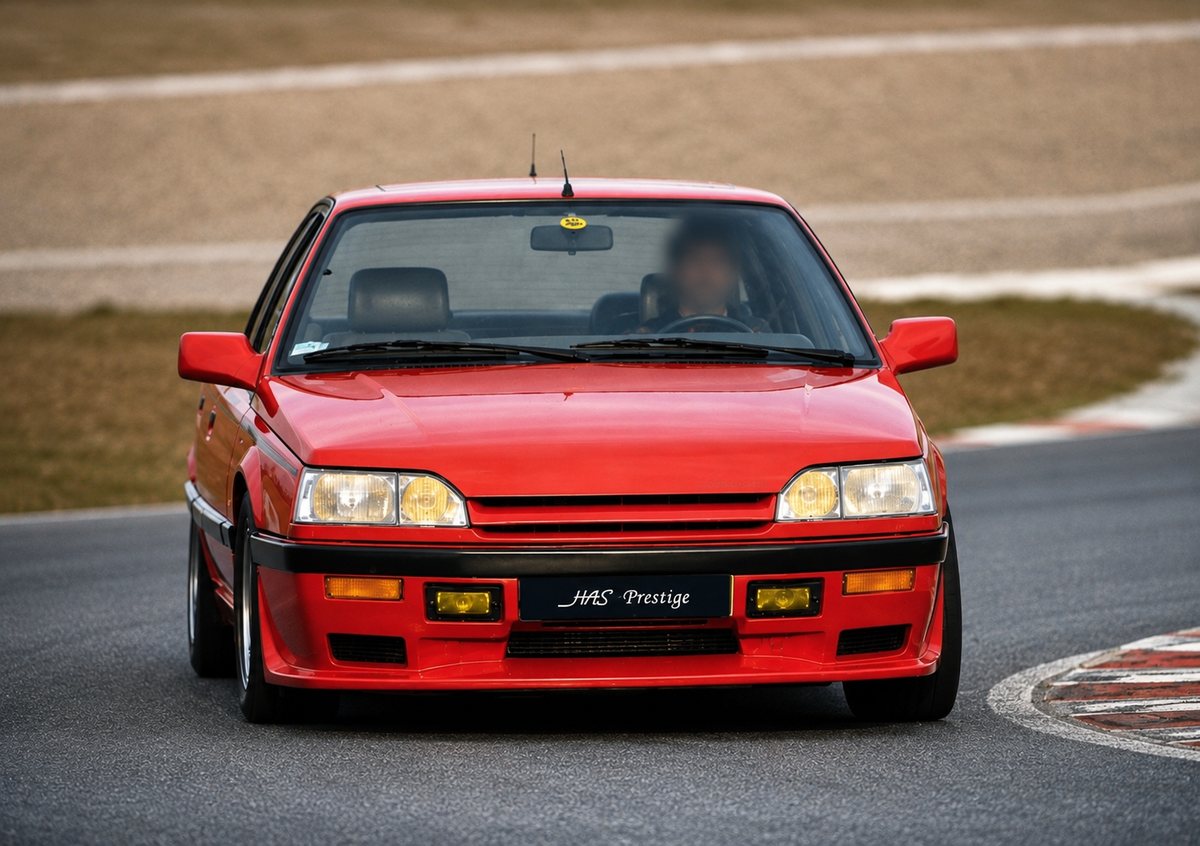
THE 25 HAS “PRESTIGE” — ≈ 240 bhp, about ten cars built
In the age of remaps, you could imagine 23 bhp gained with a flash of the EPROM. It is exactly the opposite: the Z7U 700 of 205 bhp is a deep re-engineering, entrusted to the BEREX design office and carried out — rarest of cases — as the catalytic converter arrived: the engine gained power while cleaning up.
BEREX, Dieppe's weapon. Behind the overhaul stands a name Alpine enthusiasts know well: BEREX — Bureau d'Étude et de Recherche Exploratoire. A company founded on 1 January 1979, owned 60% by Renault Sport and 40% by Alpine, based in Dieppe in the premises left vacant by the competition department: 117 people drawn from the Alpine design office and the Le Mans-winning team. Its record speaks for itself — R5 Turbo, Alpine GTA, then A610. And it was by reworking the 25 V6 Turbo that BEREX forged its emission-control expertise: the catalysed 205 bhp engine is its direct result.
| 182 bhp — Z7U 702 (1985) | 205 bhp — Z7U 700 (1990) | |
|---|---|---|
| Power | 182 bhp DIN @ 5,500 rpm | 205 bhp DIN @ 5,500 rpm |
| Torque | 28.6 m·kg from 2,500 to 4,000 rpm | 29.6 m·kg @ 2,500 rpm |
| Compression ratio | 8,6 : 1 | 8,0 : 1 |
| Boost pressure | ≈ 0,65 bar | 0,87 bar |
| Block | — | Different block, reinforced crankshaft bearings, specific oil pump |
| Valvetrain (timing) | IVO 8° · IVC 40° · EVO 40° · EVC 8° | Revised camshaft profile: IVO 12° · IVC 52° · EVO 52° · EVC 12° — longer duration |
| Turbocharging | Garrett T3 + air-to-air intercooler | Different turbo, boost control by SEM solenoid valve |
| Turbo cooling | Oil only on early cars, then water/oil became standard | Water/oil (specific reference) |
| Management | Renix electronic injection | Fenix 3B (EPROM), 3-way catalytic converter + lambda sensor |
| Throttle load | Twin switch (idle / full throttle) | Throttle body potentiometer |
| Gearbox | UN1-08 | UN1-18 |
| Tyres & wheels | 205/60 R15 | 205/55 R16 — BBS wheels on every 205 bhp car, Baccara or not |
| Speedometer | Graduated to 240 km/h | Graduated to 260 km/h |
| Steering (car) | Conventional assistance | Variable assistance |
↔ On mobile, the table scrolls sideways
The compression ratio drops from 8.6 to 8.0:1 — the engine takes more boost —, the crankshaft bearings are reinforced, the lubrication revised, and the Fenix 3B management drives it all finely through the throttle potentiometer, where the Renix made do with two switches.
Two more period details: the 205 bhp version's variable-assistance steering is speed-sensitive — firm on the motorway, light when manoeuvring. Two refinements, on the other hand, were never offered on the V6 Turbo: the automatic gearbox, deemed too fragile for the 2.5 turbo's torque, and cruise control. Visually, the 205 bhp cars are recognisable by their 16-inch BBS wheels, the wing replacing the boot spoiler — and the open front bumper spoiler feeding fresh air to the ducts that cool the brakes.
In March 1990, the V6 Turbo received the Baccara trim — as much a way of life as a trim level: leather — offered in Havane and Gris Cendre, with a few black leathers built in confidential numbers — and alcantara everywhere, walnut burr, air conditioning as standard, down to the leather suit case fitted in the boot. The marriage of the mechanical summit and grand luxury took so well that the V6 Turbo was very quickly reserved for the Baccara alone: the plain 205s of the first months are among the rarest of all.
Of the 12,728 25 V6 Turbos built across all versions (1985-1992), the Baccara is today the most sought-after — to the point that a 1992 Baccara with 3,780 km from new, straight out of the Renault Classic collection, was hammered at €58,000 (€69,600 with fees) at Artcurial's Rétromobile 2023 sale — more than double its high estimate. The fabulous turbo has become a fabulous investment.
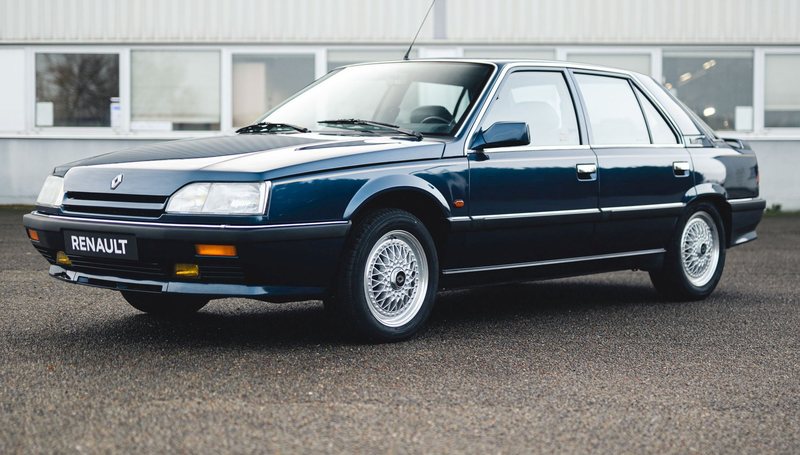
THE 25 V6 TURBO PHASE 2 — the Baccara era
Sources: period Renault advertisement (June 1985, association collection) · Z-engines Workshop Manual (Library) — compression ratios and valve timing · on BEREX: CA Dieppe Alpines club · market positioning and production: Carjager · auction result: Artcurial, Rétromobile 2023 (lot 207) · 205 details: Autos-Croisées · the site's Z7U and R25 V6 Turbo files. Spotted something? The Contribute page is there for that.
From the first turbo PRV to the 3.0 24-valve twin-turbo of the record: the whole story is on the site.