A V6 that clatters is a rocker clearance that has opened up. On the PRV Z7U 700 of a Renault 25 V6 Turbo Baccara, Maxime set the twelve rockers with a feeler gauge, using a method of his own that he explains on camera. Too tight or too loose, the right figures, the method step by step — and the film, released on 24 October on Cédric's YouTube channel.
Engine idling, bonnet up: there is no mistaking that metallic ticking. Today's Renault 25 V6 Turbo Baccara carries the Z7U 700, the 205 bhp turbo PRV V6 in its 1990 catalysed version — an evolution developed at the time by BEREX, the Bureau d'Étude et de Recherche Exploratoire. And that noise comes from the rocker clearance.
To set it, Cédric, our president, called on Maxime, who showed his method on camera, one rocker at a time. The film came out of it, with two 3D animations to understand what goes on inside the cylinder head.
This is the second episode of a series that began with the R25 Limousine and its electronics: after the electrical faults of an R25 Limousine, diagnosed with Nicolas, it is the mechanics' turn. The video comes out as a collaboration between Cédric's channel, Nicolas's — Zick'Family en camping-car — and PRV Concept's, and more episodes as a duo are on the way.
THE FILM — ROCKER ADJUSTMENT ON A RENAULT 25 V6 TURBO BACCARA (IN FRENCH) · 15 MIN 24 · @MACHOUSE78 · IN COLLABORATION WITH ZICK'FAMILY EN CAMPING-CAR AND PRV CONCEPT
Between the rocker's adjusting screw and the valve stem, there has to be a small gap: the clearance. Too tight is the sneaky case. When hot, the metals expand and the clearance disappears: the valve no longer closes fully on its seat. The result is a compression leak… without a sound. In extreme cases, the valve ends up burning.
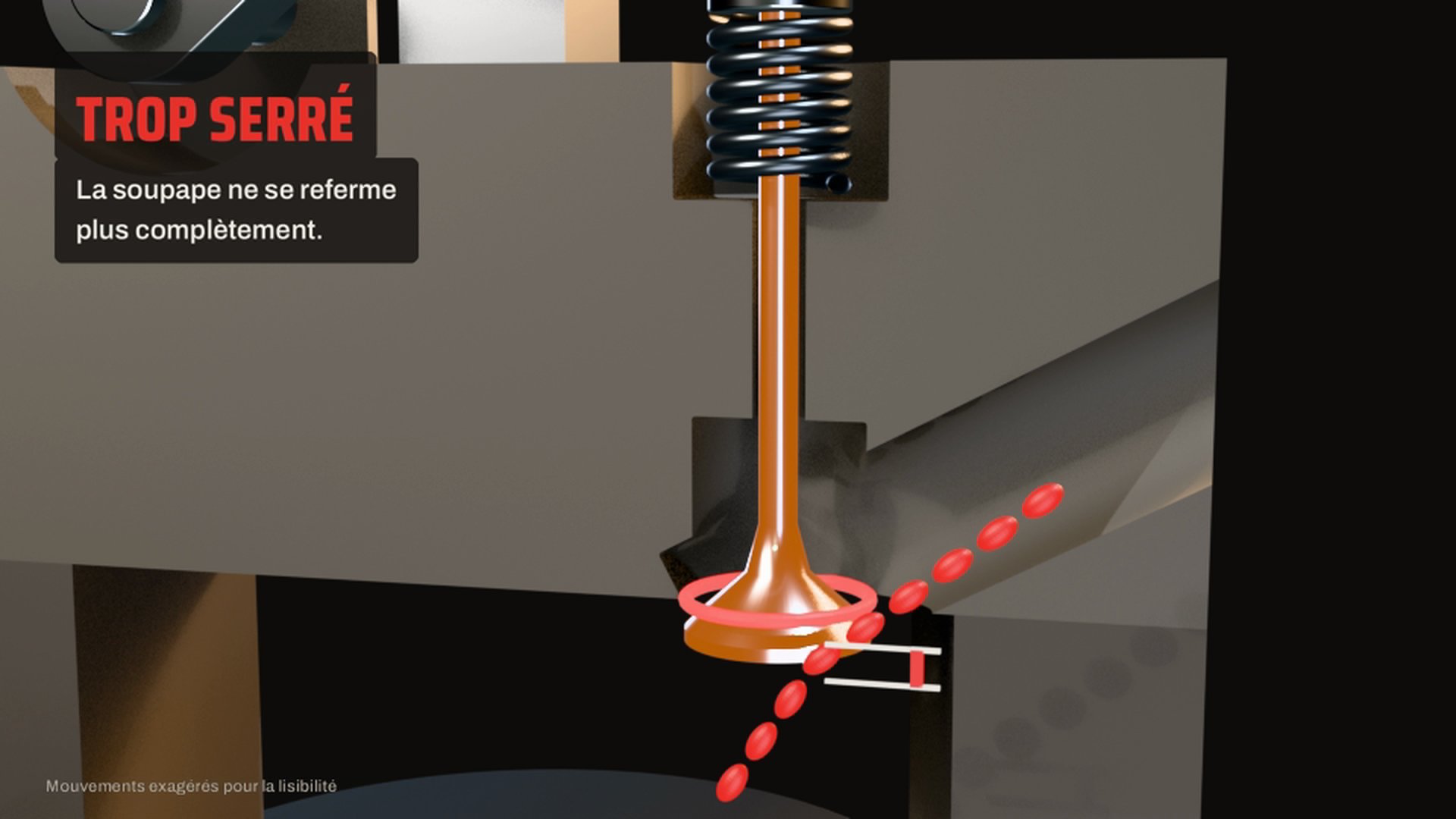
3D ANIMATION · TOO TIGHT: THE VALVE NO LONGER CLOSES · MOVEMENTS EXAGGERATED
Too loose, on the other hand, you can hear. The cam takes up the slack and the screw strikes the valve stem on every turn: that is the clatter. Not necessarily a breakdown in the making, but an engine that is not running at its best — the valve opens less, and for less time. In the long run, cam and rocker wear.
On the V6 Turbo, the adjustment is not the longest part. The engine bay is crowded: the rocker covers hide under the intake pipework and the vapour recirculation circuit, which have to come off first. Allow a good hour of dismantling before you see the first rocker — hence the point of not getting it wrong once you are in there.
On the Z7U, the clearance is set with the engine cold: 0.10 mm on the inlet side, 0.25 mm on the exhaust side. More than double on the exhaust, because it runs hotter: the metals expand more there, so it needs more allowance.
These figures are on PRV Concept: in the library, and from Père Hervé, our AI workshop foreman, who gives them when you ask for the rocker adjustment of a PRV Z7U. They are also in our FAQ.
To bring each rocker into the right position, the engine has to be turned over. On the V6 Turbo, you can no longer get at the crankshaft to turn it with a spanner: so Maxime lifts a front wheel and selects fifth gear. Turning the wheel by hand turns the engine.
Then, Maxime works one rocker at a time. He turns until the tip of the cam lobe points away from the rocker's contact point. The rocker then rests on the cam's base circle: valve closed, no load. That is the moment to adjust.
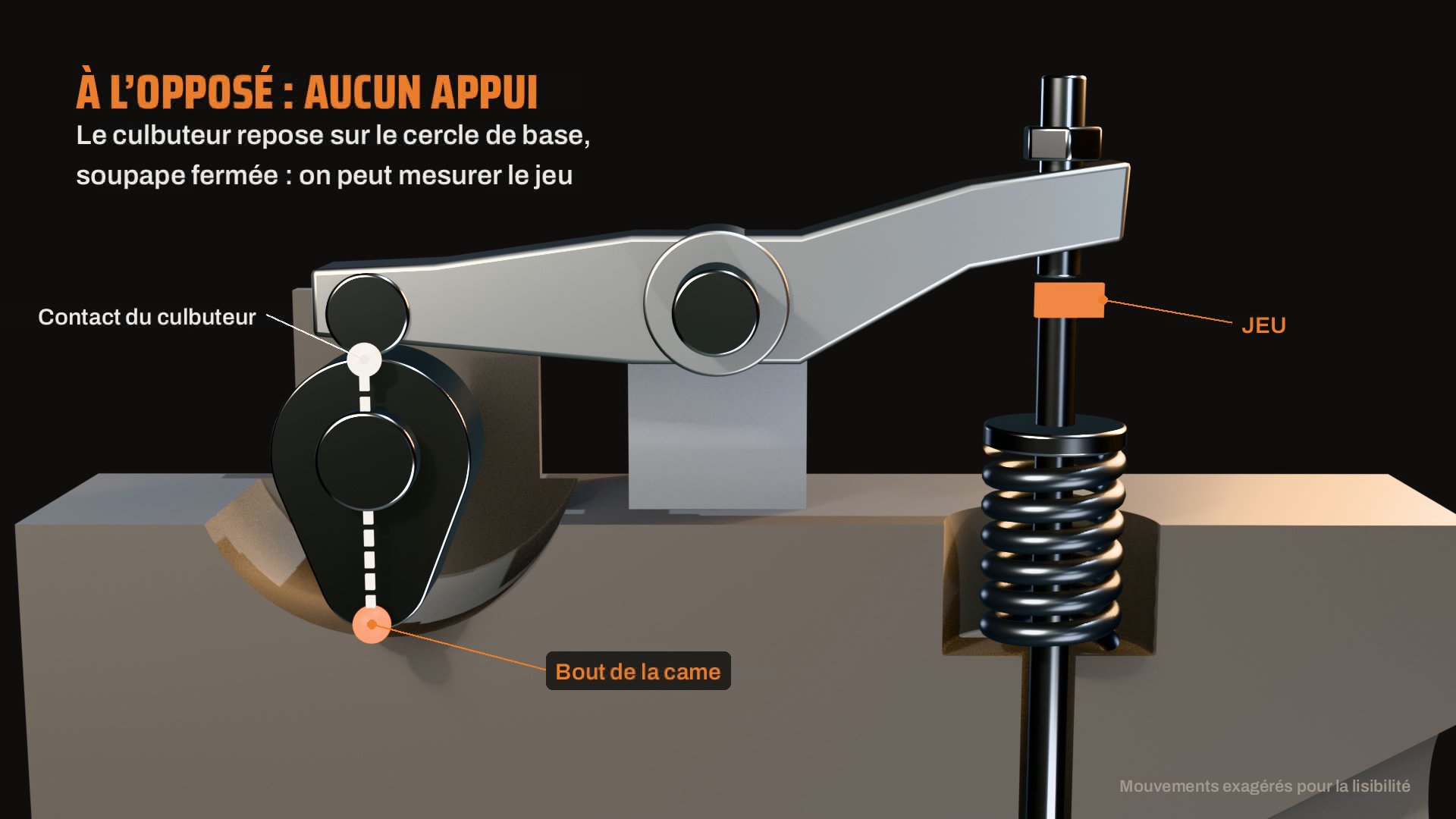
3D ANIMATION · CAM LOBE TIP AWAY FROM THE ROCKER: NO LOAD, READY TO ADJUST
The adjustment is done with a feeler gauge set, each blade numbered. Loosen the locknut, turn the screw — you can see its flat slot — until the blade slides with slight resistance, then tighten the locknut while holding the screw. For the tightening torque, the workshop manual is the reference.
And Maxime always checks with the next blade up. On the inlet, set at 0.10, the 0.15 blade must not go in: if it does, the setting is not accurate enough and you start again. On the exhaust, the 0.25 slides in with slight resistance, the 0.30 does not. Twelve valves on this PRV, so twelve adjustments.
On restart, the engine runs smoothly: much quieter, no more clatter. The film shows it as a before/after, at the same sound level, from the same shot.
Thank you to Maxime for his know-how and his patience in front of the camera. And as he keeps saying: always stick to the manufacturer's figures. Do you set the rockers on your own PRV? Tell us about your method on the forum.
Episode 1: the R25 Limousine and its electronics · The PRV Z7U V6 — the file · The R25 V6 Turbo · Renault 25 — the car and its PRV V6s · Père Hervé, our AI workshop foreman · The manuals library
Adjustment and explanations: Maxime, with Cédric (machouse) · Clearances: Z engines repair manual (MR Moteurs Z), folios 10-20 and 10-34 · Video: a collaboration between the YouTube channels of Cédric (@machouse78), Zick'Family en camping-car and PRV Concept · 3D animations: PRV Concept