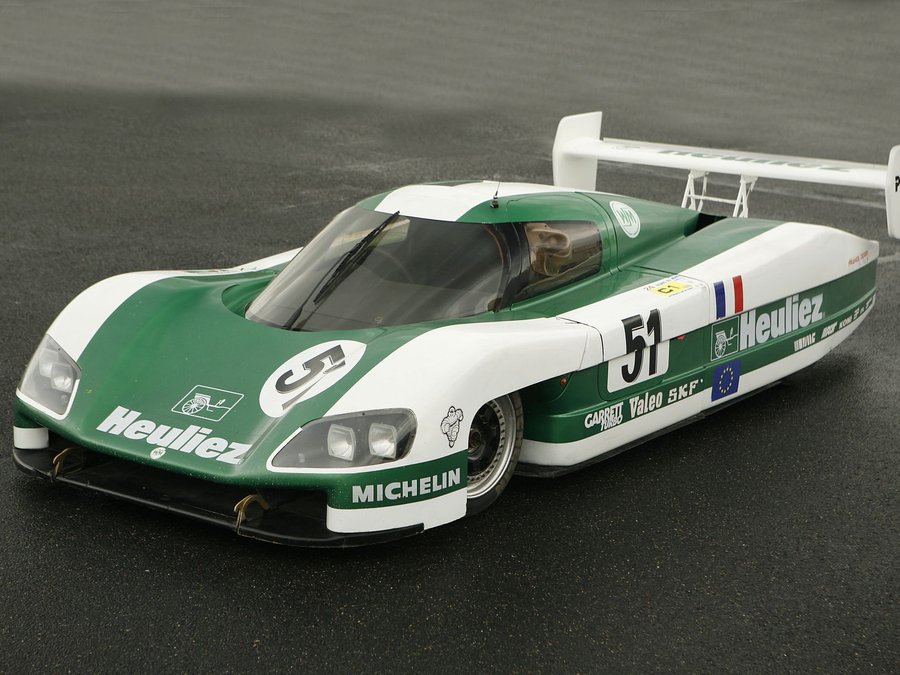
11 June 1988, 24 Hours of Le Mans. In the Hunaudières straight, Roger Dorchy's WM P88 passes the radar at 407 km/h — powered by a twin-turbo PRV V6 of around 910 bhp. Two years later, chicanes cut the straight in three. The record was frozen forever.
Gérard Welter and Michel Meunier were not engine men by trade: both worked as stylists at Peugeot. Yet every year from 1976 to 1989, their little WM team lined up at the 24 Hours of Le Mans — always powered by the PRV V6. Their goal was singular. Not overall victory, out of reach for a small private team, but one crown: being the fastest men in the world through the Hunaudières straight.
The operation even had a name: “Project 400”. Under the bodywork of the P82 then the P87, the PRV grew ever stronger — 600, then 890 bhp. In 1987 the P87 came within a whisker. For 1988, the P88 received the ultimate evolution: the ZNS5, a 2,974 cc 24-valve twin-turbo PRV pushed to around 910 bhp.
AI ANIMATION OF AN ILLUSTRATION — THE WM P88 AND ITS 407 KM/H ARE GENUINE; THIS FOOTAGE IS NOT ARCHIVE FILM.
During the 1988 race, Roger Dorchy launched the P88 down the six-kilometre straight. The radar caught it: 407 km/h. No car had ever gone faster at Le Mans — and to this day, none ever has.
A savoury detail: the figure was officially announced as “405 km/h”… to coincide with the launch of the brand-new Peugeot 405. The real number, 407, would itself become the name of a Peugeot model years later. When your record is so big that carmakers name their cars after it, twice — you have made history.
In 1990, for safety reasons, two chicanes were added to the Hunaudières, cutting the six-kilometre straight into three sections. Top speeds instantly dropped well below 400 km/h — and they have stayed there ever since. No car racing at Le Mans will ever see a straight long enough again.
That is what makes the P88's mark unique in motorsport: not a record waiting to be broken, but a record that CANNOT be broken. The rules of the track itself protect it. And at its heart sits the same 90° V6 architecture that powered a 125 bhp Volvo saloon — pushed here to 910 bhp.